Fantastic Four Key Issues: #1, #48 and #52, and How Grade Moves Them
Published Oct 10, 2026 · Updated Oct 11, 2026 · 3 min read
Short answerThe key issues of the original Fantastic Four comic are #1 (November 1961, the team's debut), #48 (March 1966, first Silver Surfer and Galactus) and #52 (July 1966, first Black Panther). On all three, the grade on a CGC or CBCS label is the main thing that moves the price.
The original Fantastic Four comic, created by Stan Lee and Jack Kirby for Marvel, runs from #1 in 1961, and three issues from its first five years account for most of the collector attention: the debut, the Silver Surfer and Galactus, and the Black Panther.
Fantastic Four #1 (November 1961)
The first issue introduced Reed Richards, Sue Storm, Johnny Storm and Ben Grimm, told their origin, and gave them the Mole Man as their first villain. It is regarded as the start of the "Marvel Age" of comics and is Marvel's most important Silver Age key after Amazing Fantasy #15. The first appearance of the Fantastic Four guide covers the issue in more detail.
Copies turn up in graded holders at the lower end of the scale, and listings on the site include a CGC 7.0, a CGC 3.0, a CGC 2.5 and a CGC 2.0.
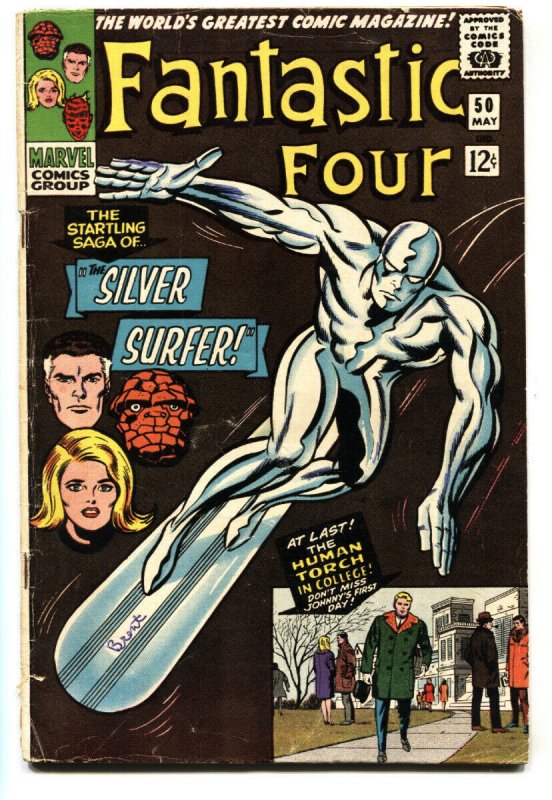
Fantastic Four #48 (March 1966)
The Silver Surfer first appeared here, in the first part of the Galactus Trilogy, with Galactus making his first (partial) appearance in the same issue. Kirby added the Surfer to the story unasked, as a herald for Galactus. The character's own series began with Silver Surfer #1 in August 1968, with art by John Buscema. See the Silver Surfer first appearance guide for the full story.
Fantastic Four #52 (July 1966)
T'Challa, the Black Panther, first appeared in #52, with his origin told in #53. He was the first Black superhero in mainstream American comics. His later milestones are covered in the Black Panther first appearance guide.
What CGC and CBCS look at on these books
Both companies grade from 0.5 to 10.0 and seal the book in a tamper-evident holder. On 1960s Marvel issues like these, the points that most often decide the number are:
- Spine: stress lines, splits and roll from reading and storage.
- Corners and edges: rounding, chipping and edge wear on the cover.
- Cover: creases, color breaks, stains, writing, stickers and tape residue.
- Staples and centerfold: rust, loose staples, and a centerfold that is detached or pulling.
- Restoration: cleaning, colour touch-up or paper added to the book is noted on the label and sits in its own label category, so it affects both the grade and the audience for the book.
How much a grade step matters depends on the issue and on demand at the time. On a key like #1, the gap between one grade and the next can be large, which is why the same issue can sell at very different prices in different holders. Rather than trusting a rule of thumb, look up recent sold prices from auction houses and marketplaces for the same issue at the same grade, and compare label type (standard or restored) as well as the number.
Choosing between graded and raw
A raw copy of an issue like #18 or #9 can be worth sending in if you think it will grade well, and the cost of grading should be weighed against the book's likely value. Graded examples on the site include Fantastic Four #18 CGC 8.0 and Fantastic Four #9 CGC 6.5. Note that "Fantastic" issues such as #8, #23 and #7 in the store are listed as a separate title and are not the original Fantastic Four run.
If you have inherited or found early issues and are not sure what you hold, the appraisal and valuation service can identify them and advise on grading. More issues from the run are collected on the Fantastic Four character page.
Frequently asked
- What is the most important Fantastic Four comic?
- Fantastic Four #1, cover-dated November 1961, which introduced Reed Richards, Sue Storm, Johnny Storm and Ben Grimm and the Mole Man. It is regarded as the start of the Marvel Age of comics.
- Which Fantastic Four issue has the first Silver Surfer?
- Fantastic Four #48, cover-dated March 1966, the first part of the Galactus Trilogy. Galactus makes his first, partial, appearance in the same issue.
- Which Fantastic Four issue has the first Black Panther?
- Fantastic Four #52, cover-dated July 1966. His origin was told in #53.
- Does CGC grade change the value of a Fantastic Four comic?
- Yes. Both CGC and CBCS grade from 0.5 to 10.0, and on key issues a higher grade generally sells for more. Check recent sold prices for the exact grade you hold rather than relying on a general figure.
Drafted with AI assistance from the facts and keywords the Rare Comics Collectors team maintains, then put through an automated fact check and our editorial rules. Spotted an error or have a question this guide does not answer? Tell us.