Character Stories

What is the first appearance of Black Panther?

Published Sep 14, 2026 · Updated Oct 10, 2026 · 1 min read

Short answerThe Black Panther, T'Challa of Wakanda, first appeared in Fantastic Four #52, cover-dated July 1966, by Stan Lee and Jack Kirby, and his origin was told in #53. He was the first Black superhero in mainstream American comics. He joined the Avengers in Avengers #52 (May 1968), his origin was retold in Avengers #87 (April 1971), and his first solo feature ran in Jungle Action from #5 (July 1973).

Fantastic Four #52

The Panther invites the Fantastic Four to Wakanda and defeats them one by one as a test. Kirby's design — the full-face mask, the technologically advanced African kingdom — was complete from the first issue. Issue #53 gives the origin, the vibranium mound and Ulysses Klaw.

Key appearances

IssueCover dateWhy
Fantastic Four #52July 1966First appearance
Fantastic Four #53August 1966Origin; first Klaw
Avengers #52May 1968Joins the Avengers
Avengers #87April 1971Origin retold; in the store as a CGC 9.8
Jungle Action #5July 1973First solo feature (a reprint of Avengers #62); #6 begins Don McGregor's "Panther's Rage"
Black Panther #1January 1977First solo title, by Kirby

Collecting Fantastic Four #52

Demand rose sharply with the 2018 film and has remained strong. High-grade copies are scarce, and the issue is a frequent target for restoration; buy graded. See the Black Panther character page and the Fantastic Four character page.

Written by the Rare Comics Collectors grading team. Spotted an error or have a question this guide does not answer? Tell us.

In the vault right now

Browse all listings →
Avengers #1 (Marvel Comics, 1963), CGC 8.5 graded comic book, Universal Blue label — front cover in its holder
MarvelCGC

Avengers

#1 · 1963

8.5
Key issueLast copy

Marvel Comics · Silver Age

Avengers #1

CGC 8.5 · Universal Blue

(9)
$95,000
Fantastic Four #1 (Marvel Comics, 1961), CGC 7.0 graded comic book, Universal Blue label — front cover in its holder
MarvelCGC

Fantastic Four

#1 · 1961

7.0
Key issueLast copy

Marvel Comics · Silver Age

Fantastic Four #1

CGC 7.0 · Universal Blue

(6)
$145,000
Avengers #14 (Marvel Comics), raw, ungraded comic book — front cover
MarvelRaw

Avengers

#14

Not graded
Last copy

Marvel Comics

Avengers #14

Raw · Not graded

(0)
$487.50
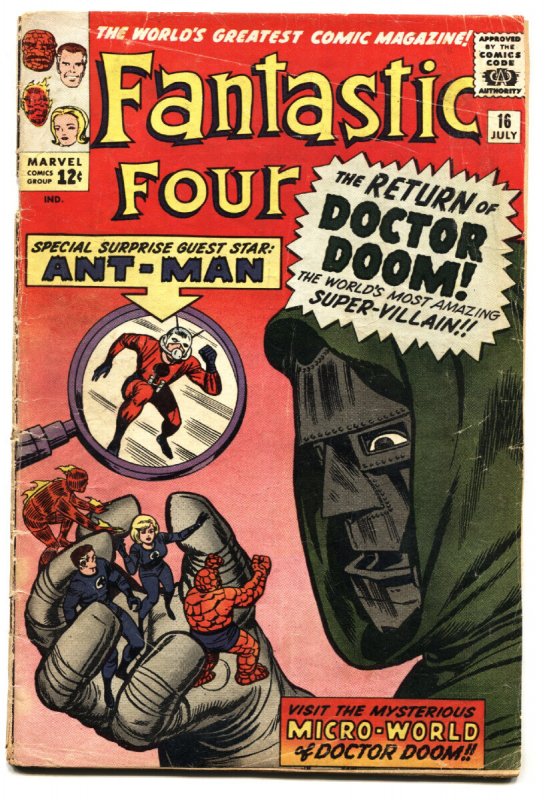
Fantastic Four #16 (Marvel Comics, 1963), raw, ungraded comic book — front cover
MarvelRaw

Fantastic Four

#16 · 1963

Not graded
Key issueLast copy

Marvel Comics · Silver Age

Fantastic Four #16

Raw · Not graded

(0)
$478.13
  • Key issues

    Fantastic Four Key Issues: #1, #48 and #52, and How Grade Moves Them

    The key issues of the original Fantastic Four comic are #1 (November 1961, the team's debut), #48 (March 1966, first Silver Surfer and Galactus) and #52 (July 1966, first Black Panther). On all three, the grade on a CGC or CBCS label is the main thing that moves the price.

    Updated Oct 11, 2026

  • Key issues

    Black Panther's First Appearance: Fantastic Four #52 and the Books Around It

    Black Panther first appeared in Fantastic Four #52, cover-dated July 1966, created by Stan Lee and Jack Kirby for Marvel Comics. His origin followed in #53, he joined the Avengers in Avengers #52 (May 1968), and his first solo feature ran in Jungle Action from #5 (July 1973).

    Updated Oct 11, 2026

  • Collecting

    What are the ages of comic books? Golden, Silver, Bronze, Copper and Modern explained

    Collectors divide American comics into eras: the Golden Age (1938 to the mid-1950s), the Silver Age (1956 to about 1970), the Bronze Age (about 1970 to 1985), the Copper Age (about 1985 to 1991) and the Modern Age (1991 to today). The boundaries are conventions rather than official dates, but each era has its own print runs, survival rates, paper and pricing, which is why listings and price guides always state one.

    Updated Oct 11, 2026

  • Collecting

    What is a key issue in comics?

    A key issue is a comic that matters for a reason beyond its story: the first appearance of a character, an origin, a first issue, a death, a famous cover, a creator's debut, or the first appearance of a costume or team. Keys are the books that hold and grow value because demand is tied to the character or event rather than to the issue's rarity alone.

    Updated Oct 10, 2026

  • Collecting

    First appearance vs cameo: what is the difference?

    A cameo is a brief appearance — often a single panel, a shadowed figure, or a last-page teaser — while a first full appearance is the issue in which the character plays a real part in the story. The market usually prices the first full appearance higher, but when the cameo is the first time the character is seen at all, both issues become keys. Incredible Hulk #180 (cameo) and #181 (first full appearance) for Wolverine is the classic example.

    Updated Oct 10, 2026

  • News

    The most expensive comic books ever sold: documented record sales

    The record for a single comic is 6 million dollars, paid for a CGC 8.5 copy of Action Comics #1 (1938) at Heritage Auctions in April 2024. Other documented milestone sales include a CGC 7.0 Superman #1 at 5.3 million dollars (private sale, 2022), a CGC 9.6 Amazing Fantasy #15 at 3.6 million dollars (Heritage, September 2021), a CGC 8.5 Action Comics #1 at 3.25 million dollars (ComicConnect, April 2021) and a CGC 9.4 Captain America Comics #1 at 3.12 million dollars (Heritage, April 2022).

    Updated Oct 11, 2026